

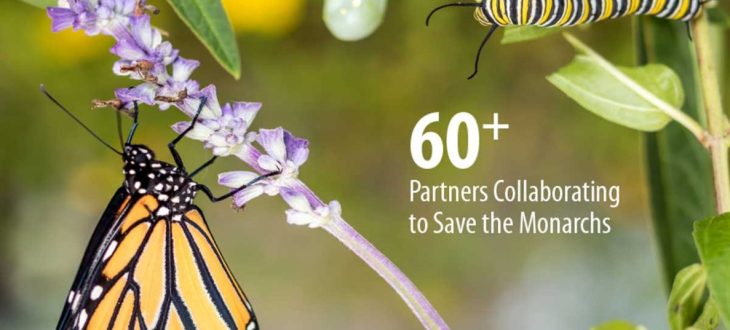
This five-year Action Plan unites state and federal agencies, tribal nations, municipalities, utility companies, researchers, educational institutions, private landowners, non-governmental organizations, and others—to advance monarch conservation across various land types in Oklahoma.
August 13, 2026
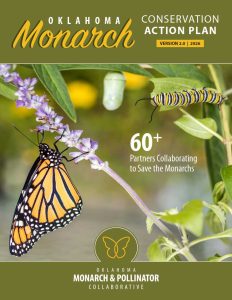

Oklahoma Monarch Conservation Action Plan Version 2.0 Cover Image. © Oklahoma Monarch Society
BY STEFANIE LELAND
To help recover monarch butterfly populations from historic declines, the Oklahoma Monarch Society (OMS) today announced the release of version 2.0 of the Oklahoma Monarch Conservation Action Plan, developed by a collaborative of 60+ partners in the Oklahoma Monarch and Pollinator Collaborative (OMPC) to guide statewide efforts to conserve monarch butterflies and native pollinators across Oklahoma. This plan provides a renewed five-year roadmap that will serve communities throughout the state interested in pollinator conservation including residents, businesses, municipalities, state agencies, private landowners, utility companies, landscapers, plant nurseries, researchers, biologists, non-governmental organizations, educational institutions, media, and more.
“Version 2.0 of the Oklahoma Monarch Conservation Action Plan is taking monarch conservation in Oklahoma to the next level,” said Katie Hawk, Executive Director of the Oklahoma Monarch Society. “As a result, we anticipate pollinator habitat becoming a top priority and normalized for local governments, businesses and residents of our great state.”
To celebrate the release of the new Action Plan, the OMS and OMPC will host two kickoff celebrations in Oklahoma City and Tulsa. These events will bring together partners, supporters and community members to celebrate progress and launch the next chapter of monarch and pollinator conservation in Oklahoma.
- OKC - OK Monarch Conservation Action Plan Kickoff Celebration
Sunday, August 23 from 1–5 p.m.
Anthem Brewing Company - 908 SW 4th St, Oklahoma City, OK 73109
- Tulsa OK Monarch Conservation Action Plan Kickoff Celebration
Sunday, August 30 from 1–5 p.m.
Heirloom Rustic Ales - 2113 E Admiral Blvd, Tulsa, OK 74110
The new plan builds on the success of the first version of the Action Plan which was launched in 2018 to coordinate and strengthen monarch conservation efforts statewide. Since then, the OMPC has united more than 60 partners—including state and federal agencies, tribal nations, municipalities, utility companies, researchers, educational institutions, private landowners, non-governmental organizations, and others—to advance conservation across Oklahoma's diverse landscapes.
The first Action Plan emphasized collaboration, outreach, and education, leading to increased statewide engagement in monarch conservation. Key accomplishments included the creation of the Okies for Monarchs education and outreach campaign, best management practice guides for rights-of-way and rangelands, monarch-friendly plant lists, training resources, expanded habitat restoration, and collaborative research and monitoring efforts.
Recognizing that more work remains to reverse monarch declines, the OMPC convened more than 100 monarch and pollinator professionals and enthusiasts representing 65 organizations at the Oklahoma Monarch Summit in August 2024. During the two-day working event, participants identified key conservation challenges—including habitat loss, mowing practices, pesticide and herbicide use, and local policies—and developed solutions to expand monarch and pollinator habitat across the state.
Over the next 18 months, the OMPC Steering Committee and partner work groups identified priority actions and created measurable objectives and strategies to guide conservation efforts over the next five years.
The updated Action Plan is organized around seven priority areas: Range and Crop Lands; Urban and Municipal Lands; Rights-of-Way; Plant and Seed Production; Research and Data Monitoring; Communications and Outreach; and Management, Partnerships and Funding.
“ODOT has been a partner with OMPC since its inception and the Agency is committed to utilizing its land system to not only provide for the safety of the traveling public but also for migrating monarchs and other pollinators,” said Vonceil Harmon, Natural Resources Monarch Program Lead for the Oklahoma Department of Transportation. “We are excited to work with other rights-of-way managers in the state through the OMPC Rights-of-Way work group to promote the importance and benefits of fully utilizing this valuable habitat.”
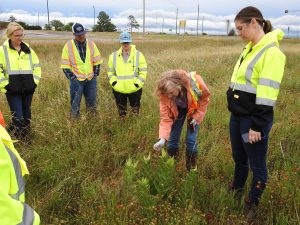
Version 2.0 provides a collaborative roadmap to strengthen habitat, improve conservation practices, expand research and monitoring, increase public engagement, and build lasting partnerships across Oklahoma. Together, these efforts will help ensure a healthier future for monarch butterflies and the native pollinators that are vital to Oklahoma's ecosystems, agriculture and communities.
Why Monarchs?
Pollinators are vital to Oklahoma’s economy and environment. They sustain the state’s agriculture by pollinating key crops like alfalfa (which supports the livestock industry) and drive native ecosystem biodiversity. According to the Oklahoma Department of Agriculture, Food, and Forestry, pollinators contribute over $157 million annually to the state’s economy.
The monarch butterfly is a key flagship species for conservation, acting as a charismatic ambassador to empower the public to take action for pollinators. Biologists refer to monarchs as the “Canary in the Coalmine” meaning their declining population serves as a warning sign about the health of the broader ecosystem. Efforts to protect monarchs benefit other pollinators, bees, birds, and native wildlife.
At this time, there is no other entity in Oklahoma leading the way with a conservation plan to save the monarch butterflies. However, there are ample organizations, government agencies, businesses and more who are doing the work. This Action Plan is important to not only organize and track existing efforts, but also to acknowledge the work that others are already doing.
And lastly, Oklahoma is centrally located in the monarch migratory path making it a vital crossroads and breeding ground for the eastern monarch butterfly, serving as a critical pitstop during both their spring and fall migrations. Its central position in the flyway makes it essential for refueling, breeding and sustaining future generations of the species.
“It’s been two years in the making and now it’s time to take flight with version 2.0 of the Action Plan. We hope you will join us on this journey as we spread our wings to explore new horizons for pollinator conservation in Oklahoma,” said Hawk.
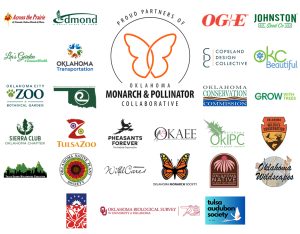
4-H/Master Gardeners
Across the Prairie
Benchmark
Canadian Master Gardeners
Chickasaw Cultural Center
Chickasaw Nation
Choctaw Nation
City of Edmond
City of Norman
City of Purcell
CLS Associates
Lia’s Garden at CommonWealth
Copeland Design Collective
Davey Resource Group
Environmental Consultant
Environmental Federation of OK
Gaylord Foundation
Grand River Dam Authority
Green Country Permaculture
Grow With Trees
Johnston Seed Company
Keep Oklahoma Beautiful
Kerr Center for Sustainable Agriculture
Kirkpatrick Foundation
KJB Outdoors
Mollie Spencer Farm
Monarch Watch
Native Plants Nursery
Natural Resources Conservation Service
New Beginnings Landscaping
Nichols Hills Environment, Health & Sustainability Commission
OG&E
OK Assoc. of Conservation Districts
OK Assoc. for Environmental Education
OKC Beautiful
OK Biological Survey
OK City Zoo and Botanical Garden
OK Conservation Commission
OK County Conservation District
OK Dept. of Transportation
OK Dept. of Wildlife Conservation
OK Ecology Project
OK Forestry Services
OK Friends of Monarchs
OK Local Agriculture Collaborative
OK Invasive Plant Council
OK Monarch Society
OK Native Plant Society
OK Native Plant Network
OK Natural Heritage Inventory
OK Quail Forever & Pheasants Forever
OK Science Museum
OK State University
OK Wildscapes
Langston University
Peach Creek Ranch
Pollinator Partnership
Pollinators & Prairies
Prairie Wind Nursery
Red Ridge Preserve
Riverfield Country Day School
Sierra Club, OK Chapter
Silver Star Construction
Tribal Alliance for Pollinators
Tulsa Audubon Society
Tulsa Urban Wilderness Coalition
Tulsa Zoo
U.S. Fish & Wildlife Service
University of OK
WildCare Oklahoma
Xerces Society
Learn more at Oklahoma Monarch Conservation Action Plan